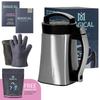
Botanical butter is best for rich, savory and baked recipes, while coconut oil is best for dairy-free, no-bake, chocolate and gummy recipes. Both make excellent herbal infusions in a countertop extractor like the MagicalButter MB2e. The right base depends on what you plan to cook, your flavor preference and any dietary needs, not on one being "stronger" than the other.
Key Takeaways
- Butter gives a rich, creamy, savory flavor and works best in baking and cooking.
- Coconut oil is dairy-free, mild and stable, and suits chocolates, gummies and no-bake treats.
- Strength depends mostly on decarboxylation, time, temperature and fat content, so both can make a high-quality infusion.
- The MB2e has preset cycles for both: about 2 hours for butter and about 1 hour for oil.
- Store infused butter in the fridge or freezer, and infused coconut oil in a cool, dark place.
What Is Botanical Butter?
Botanical butter is regular butter infused with herbs or other botanicals, so the fat carries their flavor and beneficial compounds into your cooking. Think of it as a flavored butter you can use anywhere you would use butter: spread on toast, melted into sauces, or creamed into cookie dough. In a countertop extractor, the machine grinds, heats and stirs the herbs into the melted butter for you.
What Is Infused Coconut Oil?
Infused coconut oil is coconut oil that has been steeped with herbs or botanicals in the same way. Because it is a very high-fat oil that stays stable when heated, it is a popular carrier for herbal infusions. It is solid at cooler room temperatures and melts into a clear liquid when warm, which makes it handy for chocolates, gummies, smoothies, sautéing and no-bake recipes.
Botanical Butter vs Coconut Oil: Side-by-Side Comparison
|
Factor |
Botanical butter |
Infused coconut oil |
|---|---|---|
|
Flavor |
Rich, creamy, buttery |
Mild and lightly sweet (refined versions are very neutral) |
|
Best for |
Baking, sauces, savory dishes, spreading |
Chocolates, gummies, no-bake treats, vegan and dairy-free cooking, sautéing |
|
Dairy-free |
No |
Yes |
|
Heat tolerance |
Lower; butter browns and burns more easily |
Higher, especially refined coconut oil |
|
Texture |
Soft and spreadable when cool |
Firm when cool, liquid when warm |
|
MB2e cycle |
About 2 hours |
About 1 hour |
|
Storage |
Refrigerate or freeze |
Cool, dark place |

Which Base Gives a Stronger Infusion?
Neither base is automatically stronger. How well your infusion turns out depends on four things:
- Decarboxylation. Properly activating your herbs first matters more than the base you choose. See our decarboxylation guide.
- Fat content. Coconut oil is nearly all fat, while butter also contains water and milk solids. Fat is what carries botanical compounds, which is why many people favor coconut oil for concentrated infusions.
- Time and temperature. Steady, controlled heat for the right length of time extracts more consistently than a quick or uneven cook.
- Mixing and emulsifiers. Thorough mixing, plus lecithin, helps the herbs bind and blend evenly into the fat.
This is why a machine with automatic grinding, heating and stirring gives you more consistent results than a pot on the stove.
How to Choose the Right Base
- Choose butter if you love rich flavor and plan to bake brownies, cookies and breads, or cook savory sauces and spreads.
- Choose coconut oil if you need dairy-free or vegan recipes, want a neutral taste, or plan to make chocolates, gummies and no-bake bites.
- Choose either for everyday cooking. Both work well, so go with what you already stock and love.
If gummies are your goal, an oil-based infusion fits well. Read our Gummy Making Guide for Beginners and explore the Magical Gummy Maker.
How to Make Botanical Butter in the MagicalButter MB2e
The MB2e grinds, heats, stirs and steeps for you, so the process comes down to a few steps. Always follow the manual and your recipe for exact amounts.

- Decarboxylate your herbs. Heat them in the oven or a DecarBox so the compounds are activated.
- Load the machine. Add melted unsalted butter, a splash of water if your recipe calls for it, your decarbed herbs and a little lecithin to the pitcher, staying within the fill lines.
- Set the cycle. Choose the butter setting (about 2 hours, with a temperature around 160°F) and press start.
- Strain. When the cycle ends, strain through the filter into a container, using the LoveGlove for safe handling.
- Chill. Let it cool, then refrigerate until firm.
How to Make Infused Coconut Oil in the MB2e
The steps are almost identical, which is the beauty of using one machine for both.
- Decarboxylate your herbs the same way.
- Load the pitcher with melted coconut oil, decarbed herbs and lecithin, again staying within the fill lines.
- Choose the oil setting (about 1 hour) and start the cycle.
- Strain into a clean glass jar.
- Let it set. Coconut oil firms up as it cools to room temperature or below.
Prefer the stovetop? You can steep the same mixture in a slow cooker on low heat for a couple of hours, stirring occasionally, but you will need to watch the temperature closely and the results are harder to repeat.
Making infused recipes? Use our Dosage Calculator to plan consistent servings, follow the laws where you live, and keep infused foods away from children and pets.
How to Store Botanical Butter and Infused Coconut Oil

- Infused butter: Keep it in an airtight container in the refrigerator for roughly two to three weeks. For longer storage, freeze it in small portions for up to several months.
- Infused coconut oil: Keep it in a tightly sealed jar in a cool, dark place. It generally lasts for a few months, and the refrigerator can extend that.
- For both: Use clean glass jars, label them with the date and contents, and discard anything that smells off or shows mold.
FAQ
Is botanical butter or coconut oil better for infusions?
Neither is better overall. Butter is best for rich, baked and savory recipes, and coconut oil is best for dairy-free, no-bake, chocolate and gummy recipes.
Which is stronger, infused butter or infused coconut oil?
Strength depends mostly on decarboxylation, time, temperature, mixing and fat content. Coconut oil is almost pure fat, which some people find extracts efficiently, but a well-made butter infusion can be just as effective.
Can I use the MagicalButter machine for both?
Yes. The MB2e has preset cycles for butter (about 2 hours) and oil (about 1 hour), so one machine handles both bases.
Is infused coconut oil dairy-free?
Yes. Coconut oil contains no dairy, which makes it a good choice for dairy-free and vegan recipes.
Do I need lecithin?
Lecithin is an emulsifier that helps the herbs bind with the fat and blend evenly. It is optional but widely recommended, so follow your MB2e manual or recipe.
How long does infused butter last?
Roughly two to three weeks in the refrigerator, and several months in the freezer when stored airtight. Always check for off smells or mold before using.
How long does infused coconut oil last?
A few months in a sealed jar in a cool, dark place. The refrigerator can extend that.
Can I use infused coconut oil for gummies?
Yes, oil-based infusions work well in gummies and chocolates. Pair it with the Magical Gummy Maker for even heating and mixing.
Conclusion
Botanical butter and infused coconut oil are both excellent bases, and the best one is the one that suits your recipe. Choose butter for rich, baked and savory dishes and coconut oil for dairy-free, no-bake, chocolate and gummy recipes. With the MagicalButter MB2e, you can make either one with the press of a button and get consistent results every time. Ready to start? Explore the MagicalButter MB2e and make your first batch today.